At 48 days since the outbreak of the conflict, the war in the Middle East has entered a phase in which the silence between strikes says almost as much as the strikes themselves. The truce that began on April 8 expires on April 22, the Pakistan-mediated negotiations have not yet produced a final agreement, and the U.S. naval blockade continues to weigh directly on the Iranian economy, while discussions regarding Israel, Lebanon, and freedom of navigation through Hormuz remain open, but fragile, according to Reuters and Associated Press .
This is the logic of a classic game of nerves: neither Washington nor Tehran can truly afford to appear to yield, yet neither can any longer treat the prolongation of the conflict as a cost-free option. The real question is no longer whether a formula for compromise will emerge, but who will be the first to accept a compromise presented publicly as a partial victory.
Iran is trying to endure, but its economic room is narrowing
Tehran continues to speak in the language of sovereignty and resistance, yet the material pressure is becoming increasingly difficult to ignore. The U.S. blockade has drastically reduced Iranian maritime trade, with several vessels turning back after U.S. warnings, while oil exports, especially those bound for China, have entered a zone of direct vulnerability, according to Associated Press and Reuters .
Here lies Iran’s first strategic limit. The regime can absorb high domestic political costs and can turn external pressure into a narrative of mobilization, but it cannot ignore economic reality indefinitely. Reuters notes that Iran can continue for a period without full oil exports only by using its storage capacity, but that margin is limited, and analysts’ estimates range from just over two weeks to approximately two months, depending on the actual available volume and the pace of production.
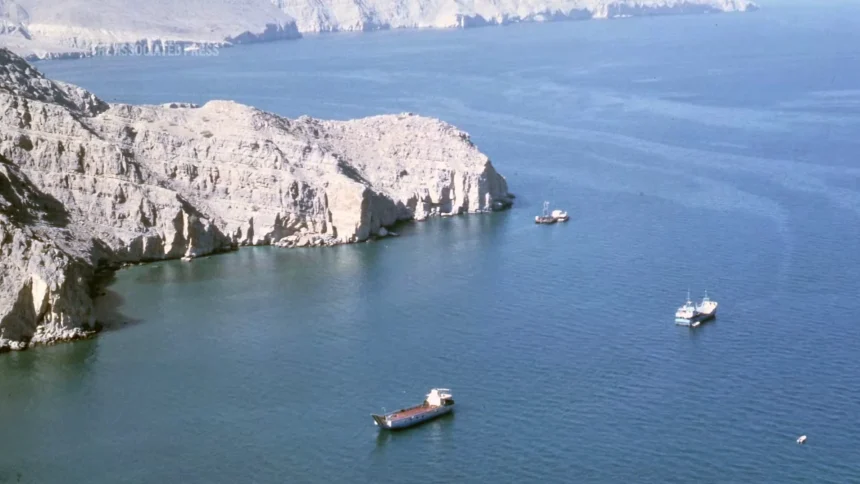
It is in this context that Iran’s proposal regarding the Omani side of the Strait of Hormuz must be read. According to Reuters , Tehran has advanced the idea of free navigation along the Omani corridor, without risk of Iranian attack, provided certain conditions are met. This is an important move not because it would amount to capitulation, but because it shows that Iran is seeking a formula to keep the negotiations alive and reduce the pressure without fully surrendering its strategic leverage.
In other words, Iran is not sending the signal of an acknowledged defeat. It is sending the signal of a controlled exit, in which it wants to determine the pace and shape of the concession.
Washington has the military advantage, but not unlimited political freedom
The United States is operating from a position of clear military superiority. Washington’s problem is that military superiority does not automatically produce a stable political victory. The blockade works as an instrument of immediate pressure, yet each additional day of tension keeps the energy crisis open and preserves the risk of domestic political costs.
On the oil market, Reuters reports that the initial price declines were constrained by investor skepticism, as markets do not believe negotiations will quickly restore flows through Hormuz. In a separate analysis, the same agency notes that the war has broken the normal relationship between the physical market and futures contracts, generating a distorted price signal and greater uncertainty for consumers, industry, and governments Reuters. For the Trump administration, this is both a strategic and a political problem: the war can be sustained militarily for longer than it can be sustained economically and electorally.
Washington therefore knows that maximum pressure has a limited window of effectiveness. If it does not produce a negotiated outcome within a reasonable time horizon, its cost begins to hit the side that imposed it as well.
The Chinese factor, the quiet pivot of the equation
The central point of this crisis is not only the bilateral relationship between the United States and Iran, but the fact that Beijing and Washington have no interest in allowing the Iranian file to explode into a broader strategic rupture between them. That is where the stake that may decisively tilt the outcome lies.
According to Reuters , Donald Trump publicly stated that he had written to Xi Jinping asking him not to supply weapons to Iran, and that the Chinese leader had responded that Beijing would not move in that direction. Reuters also notes that Trump suggested, in the same context, that the war should not alter the dynamics of his planned visit to China. The facts do not prove that Beijing is openly pressuring Tehran on Washington’s behalf. But they do show clearly that neither of the two major powers wants the Iranian file to become the trigger for bilateral escalation.
That changes the strategic calculation. China needs energy stability, it needs a minimum degree of control over maritime risks, and it needs to avoid seeing its relationship with the United States enter a new spiral of deterioration at precisely a moment when both capitals are trying to manage other major files as well. In parallel, Associated Press notes that Beijing has called for the reopening of the Strait of Hormuz and for de-escalation, clearly signaling that freedom of energy trade remains its immediate interest.
From this emerges the strongest hypothesis of the analysis: Washington is not only pressuring Iran directly. It is also pressuring the strategic context in which China has ever more reasons to signal discreetly to Tehran that prolonging the confrontation no longer serves its interests.
Who blinks first
U.S. military superiority is already well established. It has not, so far, produced Iran’s capitulation. What will determine the outcome will be, rather, the internal pain threshold of each side.
Iran has a high political tolerance for pressure and a real capacity to package economic suffering into a narrative of resistance. But its economic space is narrower, and its dependence on energy exports and important Asian buyers makes it more vulnerable than its official rhetoric suggests, according to Reuters . The United States has incomparably greater resources, but a lower domestic political tolerance for conflicts that generate energy volatility and visible economic costs, as Reuters also shows in its analysis of the war’s effects on the oil market.
If the truce is extended, this will not mean that one side has won decisively. It will mean, rather, that both sides have chosen to postpone the moment of truth. But that postponement does not change the substance of the problem. It merely confirms that neither Washington nor Tehran has yet found a formula for ending the conflict without serious strategic costs.
At this moment, all the important signals indicate that the pressure is accumulating more rapidly on Tehran. Not because Iran has already been militarily crushed, but because the major actors that truly matter to the region’s energy and diplomatic equation appear increasingly unwilling to bear alongside it the cost of a prolonged confrontation. And in a game of nerves of this kind, the first to blink is not necessarily the weaker side, but the side that first understands that the domestic bill has become greater than the symbolic advantage of resistance.