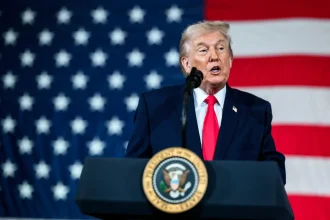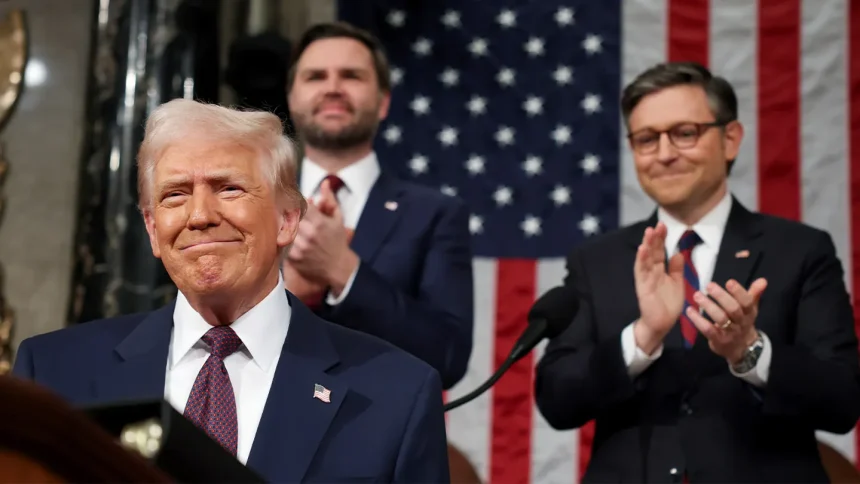
Tariff policy has returned to the center of the American presidential agenda after President Donald Trump used his State of the Union address to reaffirm that trade tariffs represent the “backbone” of his economic strategy. The message was delivered at a sensitive moment, marked by a recent decision of the Supreme Court of the United States limiting the use of certain executive instruments in trade matters.
The address brought back into focus one of the defining themes of Trump’s political career: economic protectionism and the reduction of the trade deficit through the imposition of tariffs on imports deemed strategic.
Tariffs as an Instrument of “Economic Security”
In his remarks before Congress, President Trump described the Supreme Court’s ruling as:
“an unfortunate ruling”
He indicated that his administration would seek alternative legal grounds to continue its tariff policy, arguing that tariffs have generated substantial revenues and strengthened the United States’ negotiating position in international trade relations.
Within this framework, tariffs are presented not merely as fiscal mechanisms, but as geopolitical tools designed to correct trade imbalances and safeguard strategic American industries. The White House has repeatedly maintained that external dependencies — particularly in sectors such as semiconductors, energy, and steel — constitute systemic vulnerabilities.
Voter Reactions: Republican Support, Moderate Skepticism
A real-time voter panel conducted by Maslansky & Partners revealed a sharply polarized response.
Republican participants assessed the tariff segment positively, viewing the policy as necessary in the context of intensified economic competition with China and other emerging economies.
By contrast, independents and Democratic voters expressed reservations, citing concerns about potential effects on the cost of living and the risk of higher consumer prices.
This divide reflects a broader structural debate within the American economy: the protection of domestic production versus the preservation of an open global trading system.
Constitutional Stakes: Executive Authority vs. Congress
The decision of the Supreme Court of the United States introduces a significant constitutional dimension. The Court limited certain executive prerogatives in the tariff domain, holding that the establishment of trade regimes ultimately falls within the authority of Congress.
For the Trump administration, this ruling is viewed as a constraint on the executive branch’s capacity to respond swiftly in the context of modern “economic wars.” Supporters of the president argue that executive flexibility is essential when confronting aggressive trade practices in a rapidly evolving global marketplace.
The European Echo: The Firm Position of MEP Rareș Bogdan
The debate has extended beyond U.S. borders. Romanian Member of the European Parliament Rareș Bogdan publicly defended the logic behind Trump’s tariff policy, stating:
“The U.S. Supreme Court is disarming America in the face of economic warfare.”
In his analysis published by Atlas News, he argued that the Court’s decision “weakens America’s capacity to defend itself in a context of global economic competition” and criticized what he described as an excessively formalistic legal approach.
Bogdan further maintained that a trade deficit amounting to hundreds of billions of dollars is not merely an economic indicator, but a strategic vulnerability. In his view, limiting executive instruments may create “strategic paralysis” at a time when Western economies face systemic pressures.
Between Protectionism and Inflationary Risk
Critics of the tariff policy argue that additional duties on imports are likely to be passed on to consumers through higher prices. Supporters, however, contend that any short-term impact is outweighed by long-term structural benefits for domestic production and national economic security.
As the United States approaches the midterm elections, the economy remains the primary metric by which the administration is assessed. In this context, tariffs are not merely a trade policy tool, but a symbol of the broader economic direction embraced by the White House.
A Defining Confrontation for American Economic Doctrine
The reaffirmation of tariff policy in the State of the Union address was not a rhetorical episode, but a doctrinal consolidation. President Trump made clear that he does not intend to relinquish this instrument, even in the face of legal obstacles.
The polarized reactions suggest that the debate is far from settled. At stake is not only the architecture of U.S. trade policy, but the underlying philosophy governing the relationship between state authority, market forces, and economic sovereignty.