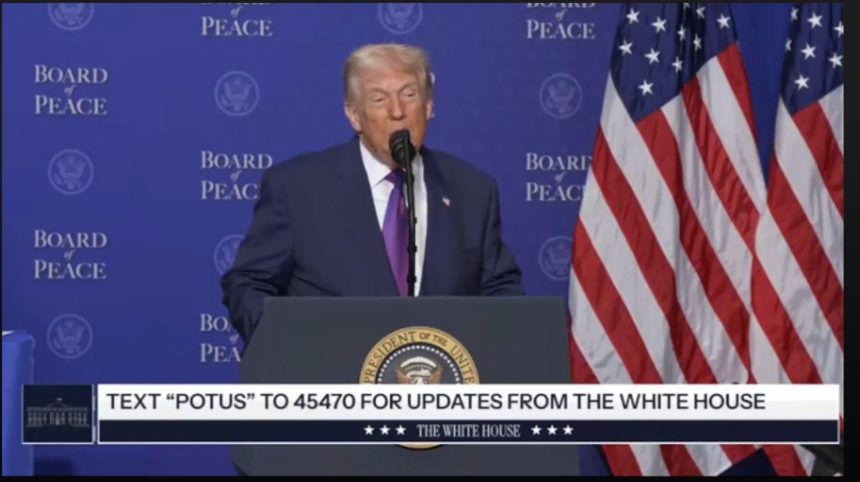
Board of Peace is not merely a diplomatic initiative, nor simply a declaration of strategic intent. It is, at its core, a demonstration of operational power and, simultaneously, a geopolitical reality test. Through this move, the United States did not seek solely to create a new mechanism of stability. It pursued something deeper and more consequential: to identify, clearly and without ambiguity, those partners upon whom it can rely in a world once again defined by competition, risk, and accelerated decision-making.
The international order formally rests on alliances, but history has repeatedly shown that the difference between theoretical alliances and operational partnerships becomes visible only in decisive moments. Board of Peace represents precisely such a moment. It was not a conventional summit, where participation is symbolic and consequences remain limited. It was an exercise in strategic clarification, in which the United States established a concrete framework and observed reactions. Some aligned without hesitation. Others participated cautiously. Some hesitated. Others maintained distance.
This clarification is not a secondary outcome. It is one of the initiative’s essential purposes.
In periods of stability, alliances can afford ambiguity without immediate consequences. In periods of instability, ambiguity becomes a strategic liability. Dominant powers must understand not only who their formal allies are, but who their real operational partners are—those willing to act when initiatives move beyond rhetoric and enter the realm of execution, those prepared to assume political, diplomatic, or economic costs in support of a shared strategic framework.

In this sense, Board of Peace functioned as a geopolitical test of alignment.
The United States did not formally demand loyalty. It did not issue ultimatums. It did not impose obligations. It did something far more effective. It created a strategic reality and observed who chose to be part of it. In geopolitics, this method is far more revealing than any formal declaration. Statements can be adapted. Positioning in a decisive moment cannot be concealed. Through this process, Washington gained clarity regarding the true architecture of contemporary alliances—not the one described in treaties, but the one defined by real decisions and real commitments. Such clarity is indispensable for any effective global strategy.
Alongside this test of strategic alignment, Board of Peace introduces another defining element: speed as an instrument of power.
The contemporary world no longer operates at the pace of institutions designed for a previous century. Traditional multilateral structures function through gradual consensus, prolonged deliberation, and the avoidance of risk. This model proved effective in an era of relative stability. In an era of accelerated competition, it becomes a structural vulnerability.
The United States recognized this transformation earlier than most global actors. Across its recent strategic actions, one element has remained constant: decisional speed—the capacity to convert strategic assessment into operational action without delay. Board of Peace reflects this doctrine.
It was not preceded by years of sterile consultation. It was not immobilized by endless negotiation. It was conceived and operationalized with a speed that reflects a fundamentally different philosophy: stability is not preserved through indefinite deliberation, but through the ability to act before instability becomes irreversible.
Speed, in this context, is not merely a tactical advantage. It is a structural determinant of power.
The actor who acts first defines the parameters within which others must respond. Those who react slowly do not shape reality. They adapt to it.
Board of Peace embodies this reality.
The initiative marks a transition from a global order defined primarily by procedural legitimacy to one defined by operational capability. In this emerging environment, legitimacy is no longer determined exclusively by institutional formality, but by the capacity to produce tangible stability.
This transformation carries profound implications for all major powers and alliances. For American allies, Board of Peace offers clarity. It confirms that Washington is not merely committed to stability in abstract terms, but is prepared to construct concrete mechanisms to sustain it. For actors seeking to exploit uncertainty, it conveys a different signal: the strategic vacuum that has existed in recent years is beginning to close.
Yet perhaps the most consequential effect is structural. Through this initiative, the United States has not simply created an operational mechanism. It has created a moment of truth. It has given every international actor the opportunity—and the necessity—to define its position within a new strategic reality.
In geopolitics, such moments are rare, but decisive. They separate theoretical alliances from real partnerships. They distinguish actors who participate in shaping global order from those who merely adapt to it.
Board of Peace is such a moment.
It is not simply a diplomatic initiative. It is the beginning of a global process of strategic clarification—a process in which speed, decisiveness, and operational capability emerge as the defining elements of power.
In this process, the United States is not merely responding to global change.
It is defining it.
Read also
Gold at $5,000 per Ounce: The Classic Signal That the World Is Entering a Risk Phase