The relationship between Belgrade and Cairo is currently witnessing a profound transformation, evolving from a storied historical friendship into a proactive, multi-layered strategic partnership.
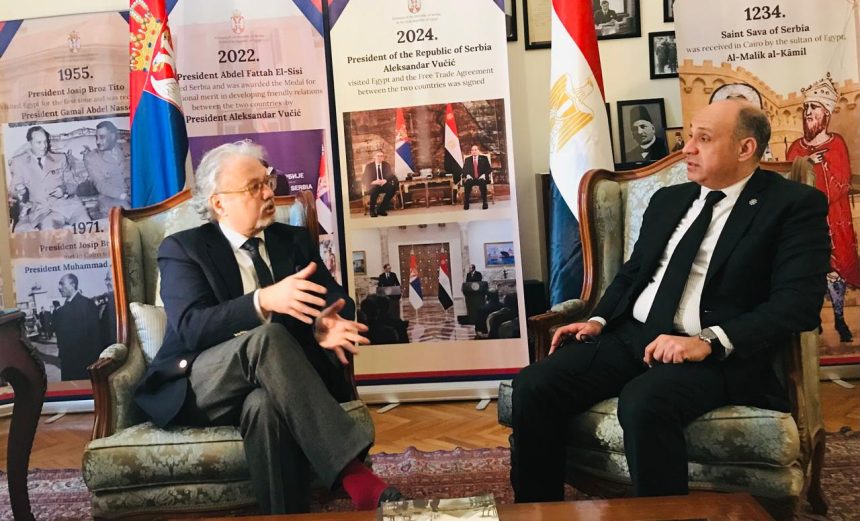
In exclusive interview to Atlas News, Serbian Ambassador to Egypt Miroslav Šestović outlines the ambitious roadmap for this „new golden age,” headlined by a comprehensive Free Trade Agreement that entered into force in September 2025.
The exclusive interview coincides with Serbia’s celebrations of its National Day, Armed Forces Day, and marking 118 years since the establishment of diplomatic relations between the two countries.
Following the landmark presidential visits of 2022 and 2024, both nations have signaled a commitment to move beyond the nostalgia of the Non-Aligned Movement (NAM) to „sync their futures” in an increasingly unpredictable world.

As Serbia prepares to open its first African Chamber of Commerce office in Cairo, Ambassador Šestović explains why Egypt is now positioned as the vital hub for Serbia’s economic expansion across the continent.
He highlighted the „Skilled Labor Bridge” to Egypt’s anticipated participation in the Specialized World Expo 2027 in Belgrade, the Ambassador details how the two nations are integrating their supply chains and energy strategies.
Atlas News (AN): How would you describe the „strategic partnership” following the 2022 and 2024 presidential visits?
Miroslav Šestović: Two major presidential visits in three years ushered in a new golden age in our relations. They vindicate the Egyptian adage that “the best friend is one unchanged by time or wealth“. Equally important, they reflect the fact that relations between states, based on mutual respect, international law and fundamental principles of international relations, as is the case with Egypt and Serbia, will persist in the face of challenges posed by an unraveling world order that we are all witnessing today with great concern. With these visits our relationship evolved from a traditional to a proactive, multi-layered one. We are no longer just talking about history, we are committed to actively sync our futures.
AN: How does the Non-Aligned Movement (NAM) heritage influence modern trust?
Šestović: Presidents Tito of Yugoslavia and Nasser of Egypt forged a golden age of our relations at the height of the world struggle against colonialism and for national liberation. We all remember that, together with Nehru of India, they were the NAM founding fathers. The first NAM Summit was held in Belgrade in 1961. The NAM principles are part of our „diplomatic DNA” which forms an enduring foundation for mutual respect and understanding. Belgrade and Cairo share a common „political language” that promotes mutual trust in an increasingly unpredictable multi-polar world.
AN: How do you coordinate on Middle East and Balkan security?
Šestović: By maintaining a constant dialogue. We are committed to respecting international law and UN Charter’s fundamental principles. Hence, both nations act as sovereign anchors of peace and stability in their respective regions. We coordinate efforts towards advocating de-escalation and emphasize that regional security is interconnected—instability in the Middle East invariably affects our region and vice versa.
AN: How is the principle of territorial integrity reflected in joint statements?
Šestović: It is a red line. In international fora, we consistently support the UN Charter. We believe that respecting the territorial integrity in accordance with international law is the only way to prevent global chaos and our statements serve as a firm reminder of this shared stance. Respect of UN Charter and consequently, of the territorial integrity and sovereignty of member states is of essential and vital importance if we are to overcome the challenges of an ever-changing and increasingly unstable world.
AN: What is the roadmap to reaching the $1 billion trade milestone?
Šestović: The milestone is the Free Trade Agreement between our countries, initiated during the historic visit of President Sisi to Serbia in 2022 and signed during President Vucic return visit in 2024. It is officially in force since September 1, 2025. Hence, the roadmap relies on economic diversification and the removal of trade barriers. The Chamber of Commerce of Serbia is in the final stages of opening its office in Cairo, the first one in Africa. A conservative estimate on our side is that our trade will triple over a short period due to these new beneficial circumstances.
We seek to achieve this goal by moving beyond traditional commodities to high-tech services, defense cooperation, and specialized manufacturing. At the same time, our mutual keen interest is to reopen direct flights between our two capitals and to increase the number of flights between Belgrade and Hurghada. We are also focusing on establishing a Joint Business Council to additionally facilitate direct „B2B” networking between Serbian and Egyptian entrepreneurs. All these elements reflect an ambition to turn Egypt into a hub for the advancement of our economic cooperation with the African continent.
AN: Which sectors will see immediate growth following the Free Trade Agreement (FTA)?
Šestović: Upon entry into force, nearly 50% of agricultural products and 30% of industrial products were exempted from custom duties. Over the next 10 years, the agreement aims to achieve full duty-free status for more than 90% of all products. The deal also streamlines certification and administrative procedures, aiming to reduce non-tariff barriers. Therefore, we expect an immediate surge in agriculture, pharmaceuticals and industrial machinery. The FTA removes the customs duties that previously made our goods less competitive which will allow Serbian food products to reach Egyptian tables at a lower cost and Egyptian industrial components to integrate into Serbian supply chains and vice versa.
AN: How can Serbia support Egypt’s food security?
Šestović: Serbia offers the export of its surpluses of wheat, corn and sunflower oil. Given Serbia’s strong position in agricultural research, hybrid seeds are among the strategic Serbian exports. Joint research and technological assistance, including state-of-the-art technology, for development of seeds tailored for arid climates are a very promising field of cooperation. We are not just looking to sell products, we wish to cooperate with Egypt in order to build a resilient agricultural production and infrastructure. This includes transferring knowledge in agrotechnology, ensuring a stable food supply chain for Egypt’s population.
AN: Are there opportunities for energy collaboration?
Šestović: Absolutely. Serbia is rapidly diversifying its energy sources. Egypt has the potential to become one of the pillars of this diversification strategy. That partnership may be anchored in three key areas: LNG, renewable energy and electrical energy. As Egypt positions itself as a regional energy hub, we see great potential also in Green Hydrogen. Serbia is exploring technical cooperation to integrate these future fuels into its industrial sector. This would involve combining Egyptian production capabilities with Serbian investment in power distribution and renewable energy integration. Serbian engineering firms are interested and are studying the prospects of participation in Egypt’s grid modernization and digitalization efforts.
AN: How do the Suez Canal Economic Zone and Serbia act as regional hubs?
Šestović: It’s a „Gate-to-Gate” strategy. Serbian investors can use the Suez zone as a manufacturing base to access the African Continental Free Trade Area (AfCFTA). Conversely, Egyptian firms can utilize Serbia’s strategic position and its own network of FTAs to act as a primary logistics hub for entering wider Balkan and European Union markets duty-free. Serbian energy and infrastructure firms are increasingly looking at the SCEZ for joint ventures, particularly in manufacturing components for energy sector.
AN: What framework is being built for Egyptian workers in Serbia?
Šestović: The framework for labor cooperation was established in July 2024 with the signing of the MoU, during the visit of President Aleksandar Vucic to Cairo. Since then, the two labor ministers have been regularly meeting in order to activate a streamlined „Skilled Labor Bridge” to address Serbia’s growing demand for stable, skilled labor force. This framework ensures robust legal protection, fair wages and appropriate visa-processing procedures for Egyptian professionals and labor force. It is designed to be a win-win: providing Serbia with the talent needed for our massive infrastructure projects like Specialized EXPO 2027 and the soon to be announced Vision 2035, while offering Egyptian workers valuable international experience.
AN: What cultural programs are planned for 2026?
Šestović: When it comes to Serbia, our main focus in 2026 will be the preparation for the hosting of the Specialized World Expo 2027. It will take place in Belgrade, from May 15 – August 15, under the theme “Play for Humanity: Sport and Music for All“. EXPO27 will serve as a major international platform for countries of the world to showcase innovation, culture and progress. We are pleased and honored by the decision of Egypt to participate with its national pavilion and I am convinced that it will be among the most impressive ones. We are also proud to announce that more than 130 countries have officially confirmed their participation thus setting a record in terms of the number of countries participating at a Specialised World Expo. More than four million visitors are expected to attend more than 8 thousand planned separate performances, concerts and sporting events.
When it comes to culture, one cannot forget last year’s election of Dr. Khaled El Enany to the position of UNESCO Director General. Serbia has given its official support in the very early stages of the candidacy, in line with our strong and friendly bilateral relations, in particular in the multilateral arena where mutual support is usually the order of the day. Dr. Enany’s election is of historical importance as a tribute to a person that embodies unique cultural and civilizational heritage.
AN: Are there plans to increase direct flights?
Šestović: Tourism demand is skyrocketing, in particular since the opening of the Grand Egyptian Museum, and air connectivity must keep pace. We are currently negotiating with national carriers and airlines from both countries to increase the frequency of year-round flights from Belgrade to Hurghada and resume direct flights to Cairo. Promoting these routes is essential not only for tourists seeking to visit the Red Sea but also for a growing number of Egyptian tourists interested in visiting Serbia including business people traveling between our two capitals.
Read also
Ambassador Ghanem Saqr Al-Ghanem: Kuwait–Egypt Relations Have Reached Their Highest Level in History