Atlas News – Editorial Analysis
The global security environment is entering a more fragile phase, not because major powers are preparing for direct confrontation, but because long-standing mechanisms of strategic stability are eroding. Nuclear arms control, as it has been known for decades, is no longer in place. In the absence of binding treaties, direct military communication channels are becoming a central tool for risk management. Predictability is giving way to crisis procedures, and legal frameworks are being replaced by operational safeguards.
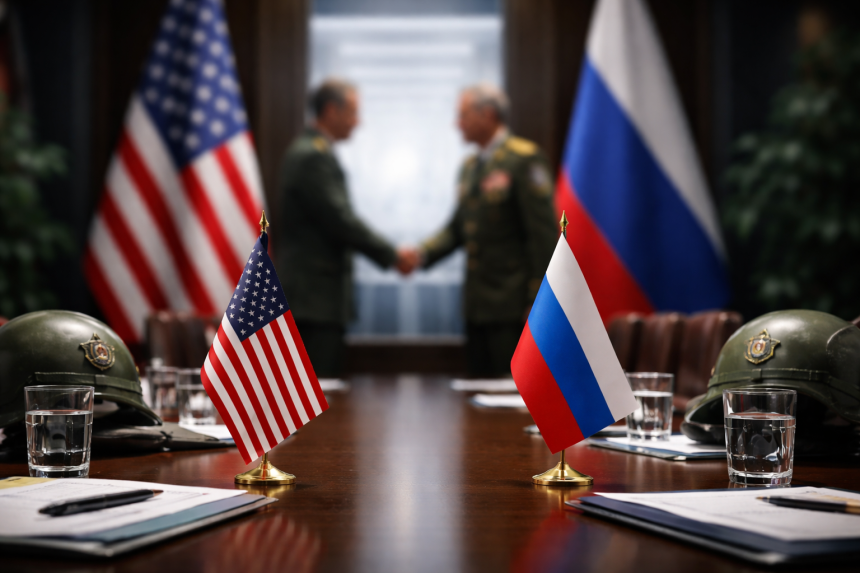
The decision by the United States and Russia to resume high-level military dialogue must be understood within this broader strategic context. It is not a political rapprochement, but a pragmatic adjustment to a more unstable international environment.
Why Military Dialogue Has Become Essential
Military-to-military channels are not activated in times of strategic calm. They are restored when tensions reach levels that make miscalculation increasingly dangerous. Their primary purpose is not conflict resolution, but accident prevention.
In an environment marked by heightened military activity, exercises, aerial interceptions, and an ongoing conventional war in Europe, the most serious risks arise not from deliberate decisions, but from errors. Misinterpretation of intent, delayed communication, or unintended escalation can rapidly produce consequences that exceed political control.

Military dialogue provides a safety valve. It enables rapid clarification, operational boundaries, and de-escalatory signaling. It does not create peace, but it can prevent a crisis from spiraling into catastrophe.
The Strategic Significance of New START’s Expiration
The expiration of New START marks the end of the last verifiable framework limiting U.S. and Russian strategic nuclear arsenals. What disappears is not only a numerical cap, but a system of inspections, transparency, and strategic discipline.
Without this framework, each side is forced to assume worst-case scenarios about the other’s capabilities and intentions. In military planning, such assumptions are sufficient to trigger reactive force postures and long-term competitive dynamics.
Public assurances of “responsible behavior” are diplomatically meaningful, but they do not substitute for verification. In strategic stability, credibility is built on mechanisms, not statements. Without enforceable rules, uncertainty becomes structural.
From Treaty-Based Stability to Procedural Stability
For decades, nuclear stability was anchored in legally binding agreements. That era has effectively ended. What is emerging in its place is a form of procedural stability, sustained through communication, informal protocols, and professional restraint.
This model is inherently more fragile. It depends on political will, institutional continuity, and crisis management competence. It is vulnerable to domestic political shifts, leadership changes, and moments of acute stress.
The resumption of military dialogue reflects this reality. It is a necessary adaptation, but not a substitute for comprehensive arms control.
Ukraine and the Separation of Strategic Levels
The war in Ukraine continues to generate structural tension between Russia and NATO, even in the absence of direct military confrontation. In this context, U.S.–Russia military dialogue serves a clear purpose: preventing the conflict from escalating into a direct nuclear-level confrontation.
A separation is emerging between two strategic levels. Political negotiations over Ukraine remain constrained by incompatible objectives, while global risk management proceeds on a parallel track. This separation is neither cynical nor conciliatory. It is a reflection of strategic realism.
NATO, Europe, and Strategic Adjustment
For NATO, the implications are clear. Deterrence must be reinforced, and stability can no longer be assumed. This explains the alliance’s emphasis on air defense, industrial capacity, and preparedness across multiple contingencies.
For Europe, the moment is more uncomfortable. Long-standing references to a “rules-based international order” now coexist with the reality that one of the central pillars of nuclear stability has collapsed. The gap between normative discourse and strategic reality is becoming increasingly visible.
China and the Limits of the Old Framework
Any future attempt to reconstruct arms control will have to account for China’s growing strategic role. The international system is no longer defined by bilateral equilibrium alone. Competition is global, and security architecture is increasingly fragmented.
This complexity helps explain why procedural solutions are currently favored. Establishing direct communication is faster and more feasible than negotiating comprehensive multilateral agreements. It is a short-term necessity, not a long-term solution.
Conclusion – Atlas News
The resumption of military dialogue between the United States and Russia reflects strategic clarity rather than political convergence. It acknowledges that risk levels have risen in a world where formal nuclear constraints have weakened.
The era of treaty-guaranteed stability has ended. What remains is a minimum form of stability, maintained through communication, restraint, and crisis management.
It is a world in which peace is no longer ensured by agreements, but managed day by day. A world where errors carry higher costs, and where open lines between military institutions matter more than political rhetoric.
Read also