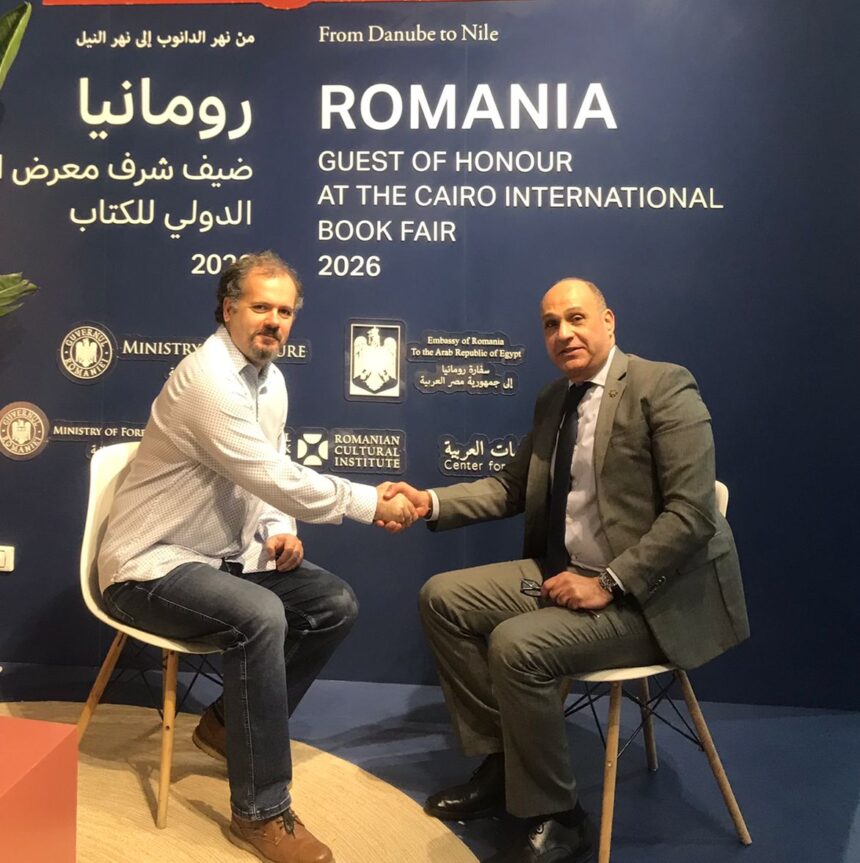
The Cairo International Book Fair (CIBF) is one of the largest and most significant book fairs in the Middle East, attracting millions of visitors each year. The 57th edition of the fair is currently underway, with Romania as the guest of honor, marking 120 years of diplomatic relations between Egypt and Romania.
Alongside the activities of the CIBF, Atlas News interviewed the Romanian author Radu Vancu, who described Romania’s participation at the fair as a pivotal moment in bilateral relations, moving beyond abstract political ties to a “concretely human” connection.
The presence of Romania as the Guest of Honor at the Cairo International Book Fair marks more than just a diplomatic milestone; it represents what author Radu Vancu calls the “amplification” of a shared cultural discovery. While Egyptian giants such as Nobel laureate Naguib Mahfuz have long enjoyed a prestigious and beloved status in the Romanian literary canon, the reverse has often been true—Romanian literature has remained largely underrepresented in the Arabic-speaking world.
Atlas News: What are your thoughts on the significance of the Cairo International Book Fair for Romanian authors?

Radu Vancu: I think this should be an amplification of the Romanian presence in the Arabic world. We are starting to discover each other.
There are Egyptian writers translated into Romanian, most of all, of course, Naguib Mahfuz, who has a very well-respected presence in Romanian literature. His books are loved; he has been widely translated, mainly by Polirom, which is perhaps the leading publishing house in Romania. We greatly admire the strength of Egyptian literature and of Arabic literature in a broader sense. However, I think the Romanian presence has been rather underrepresented in translation in the Arabic world.
So this could be, to quote the famous movie, the beginning of a beautiful friendship between our two literatures.
Atlas News: How do your works reflect the relationship between Romanian culture and the broader cultural contexts of the Arab world?
Radu Vancu: I think Romania and some of the countries in the Arab world share a history of injustice, of suffering, of a world sometimes organized in the most unjust arrangements regarding human rights. We know what it means to live in a world organized against human freedom. We know the value of suffering, the value of peace, and the value of compassion.
We have these things in common. I think we can build communication by using suffering as a shared value, suffering as a common currency through which we judge and evaluate our histories. This is the point from which we can build, and we can use words as tools for healing each other.
Atlas News: What insights do you hope to gain from interacting with Egyptian authors and readers at the CIBF?
Radu Vancu: I think the raw material for literature is the human being as a concrete presence. We tend too much to isolate ourselves from other human beings, from other concrete human beings. Much of the suffering in the world comes from this mutual ignorance of the other as a concrete being.
For example, in Romania we often know Egypt only as an abstract space, not populated by concrete human beings. By coming here—by traveling through Cairo, going into markets, museums, libraries, coming to the book fair, observing people, and talking to them—we enrich not only our literature but also our understanding of the world.
After two days in Cairo, observing people selling fruit on the streets, watching people carrying huge trays on their heads to transport bread, pretzels, or other baked goods, and talking to them helps me better understand a world I previously knew only through literature.
This is what such a book fair does: it transforms an abstract space into something very human, very concretely human.
Atlas News: How do you perceive the role of Egyptian cultural heritage in shaping contemporary literature in both Romania and Egypt?
Radu Vancu: In Romania, we mainly know figures such as Naguib Mahfuz and that cultural era. However, there is also a very rich contemporary Egyptian literature—writers such as Ahmed Murad or Omar Tahir—whose works should be present in Romania through translation.
This would help us better understand the beauty of how such an ancient history as Egypt’s can become contemporary.
In Romania, we have a literary tradition of only two or three hundred years of writing and building beauty and truth through words in Romanian. Egypt has four thousand years of cultural history—perhaps even more, but let us agree on these four thousand, which are so well documented. How is it possible to build beauty and truth after four or five thousand years of continuously writing about human beauty and human truth?
This is a very precious lesson that Egypt can teach Romanian literature, and I hope we will be able to learn it.
Atlas News: How do you think Egyptian readers might engage with the themes present in your works? Are there particular aspects you believe they would connect with?
Radu Vancu: I write both poetry and prose, and although they are rooted in Romanian themes, I believe they also address universal experiences.
For example, my latest novel, Paradise, begins with the experience of COVID. I believe that in Egypt, as well, the pandemic was felt deeply and intensely.
During the pandemic, I had fears like everyone else: Would we find a vaccine? How many of us would die? What was the lethal force of this virus? I imagined a world in which civilization ends, a world where the virus manages to eliminate almost all of humanity. A few survivors are organized by Elon Musk into a colony called Paradise. They use the Starlink system to stay connected and attempt to rebuild humanity.
The main question of the novel is whether, if most of humanity is destroyed, we still have enough strength, imagination, kindness, and belief in survival to rebuild it.
I believe this question may resonate with Egyptian readers as well, because across all cultures we are interested in the survival of humanity. Does humanity have enough strength to survive catastrophes?
I also explore very personal themes, such as the suicide of my father. I have written mainly poetry, but also prose, trying to show what it means to survive the suicide of someone you love. We all face domestic tragedies; we all lose people we love. We use words to resist, to overcome these tragedies. I think this, too, could resonate with Egyptian readers, as similar domestic tragedies exist everywhere and can be confronted through words and trust in human resilience.
Atlas News: How do you think your literary style reflects the broader cultural dialogues between Romania and Egypt?
Radu Vancu: When I write, like most writers, I do not think about a national reader. I do not think only about the Romanian reader; I think about the human reader.
I am interested in the general human response to my literature. As I mentioned before, I believe Egyptian readers can respond both to the general traumas and joys in my writing, as well as to the private ones reflected there. I hope my literature will bring a bit of joy, pleasure, and human recognition to Egyptian readers as well.
Atlas News: Finally, what is your message for Egyptian intellectuals and readers?
Radu Vancu: We live in a world that looks uglier every day—full of conflicts, wars, and tragedies. But my message is this: never forget that beauty exists, no matter how ugly the world may appear. Beauty exists, and it waits for us, ready to help us heal.
Read also