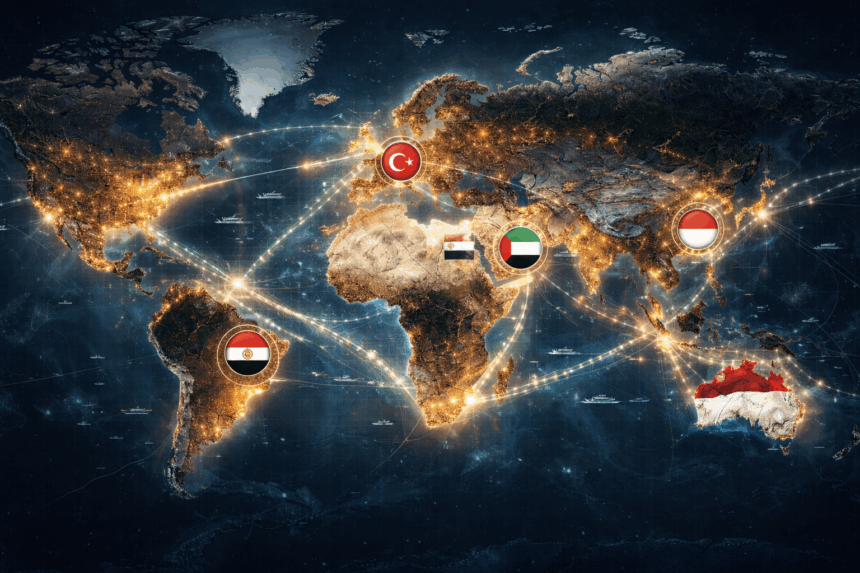
The international order is undergoing a profound transformation that can no longer be explained solely through competition among great powers. Although the United States remains the central actor in the global security architecture, and China its principal strategic competitor, the real dynamics of influence are gradually shifting toward an intermediate level: states that do not dominate the system, yet without which it can no longer function effectively.
This shift is a direct consequence of global fragmentation. The international system is not collapsing; rather, it is partially decoupling, fragmenting into regions, dossiers, and interests that can no longer be managed exclusively through broad consensus or rigid multilateral mechanisms. In this context, influence is no longer determined only by the ability to impose rules, but by the capacity to provide operational solutions: alternative routes, regional stability, diplomatic mediation, economic connectivity, and on-the-ground implementation.
It is here that the central figure of the new geopolitical phase emerges: the pivot state.
Global Fragmentation and the Relocation of Real Power
Fragmentation produces a fundamental shift in logic. Great powers are increasingly overstretched—by prolonged conflicts, economic competition, domestic pressures, and global expectations. The costs of maintaining direct control rise, while the returns on influence diminish. At the same time, the system must continue to function on a daily basis: trade must flow, energy must reach its destinations, local conflicts must be contained, and communication channels must remain open.

Within this space, pivot states emerge. They do not openly challenge the global order nor compete with great powers on their own terrain, yet they become functional nodes of the system. Control over options—who can provide access, who can stabilize, who can mediate—becomes a more valuable form of power than hegemonic rhetoric.
Key Concept: Great Powers Rely on Pivots That Support, Yet Negotiate
A crucial element, often overlooked in public discourse, is the following: great powers—particularly the United States—will always rely on pivot states that support the American strategic architecture while continuously negotiating in their own national interest. This is not a sign of systemic weakness; on the contrary, it is a condition for stability.
Pivot states are not satellites. They generate value precisely because they understand global dynamics and can translate the strategic objectives of great powers into regional realities. In return, they seek recognition, investment, access, or guarantees. This transaction is structural and healthy: it distributes costs, reduces escalation risks, and makes alliances more resilient.
Turkey: A Pivot Through Connectivity and Adaptive Diplomacy
Within this framework, Turkey represents a clear example of a pivot state operating effectively in a fragmented order. Not through brute force nor rigid alignment, but through a pragmatic diplomatic culture adapted to current trends: minilateralism, targeted negotiations, controlled transactionalism, and flexible partnerships.
Turkey does not seek to act as a global arbiter. Instead, it positions itself where great powers require interfaces: commercial and energy corridors, alternative routes between Asia and Europe, regional stability, and channels of dialogue on sensitive dossiers. This capacity to provide options explains why Turkey remains relevant even as the geopolitical environment becomes more tense.
The United Arab Emirates: Geopolitical Infrastructure Through Economy and Logistics
A different, yet complementary, model is that of the United Arab Emirates. Emirati influence is not built through political confrontation, but through the transformation of the economy and logistics into strategic instruments. Ports, financial hubs, infrastructure, and commercial networks turn the UAE into a critical node of connectivity linking Asia, the Middle East, Africa, and the West.
In a world where supply chains are treated as strategic assets, such a state effectively becomes “geopolitical infrastructure.” Its influence may not be media-spectacular, but it is exceedingly difficult to bypass in practice.
Indonesia: Functional Non-Alignment in a Key Region
Indonesia perfectly illustrates the logic of functional non-alignment. In a region dominated by competition between the United States and China, Jakarta avoids exclusive commitments and maximizes its strategic autonomy. Demographic weight, geographic position, and regional role allow it to negotiate from a position of balance rather than dependence.
This approach is not passive neutrality, but pragmatic multi-alignment. Indonesia thus becomes a regional pivot that matters in the security and economic equations of the Indo-Pacific precisely because it cannot be easily absorbed into a single camp.
Egypt: A Factor of Balance and Regional Stability
In the Middle East and North Africa, Egypt plays an essential role as a factor of balance. Its geostrategic position, institutional capacity, and extensive diplomatic network across Africa make it an indispensable actor for regional stability.
Egypt is a serious strategic partner of the United States and, at the same time, a credible interlocutor for Arab states. Its role as mediator and stabilizer in sensitive dossiers does not stem from hegemonic ambitions, but from its ability to maintain functional channels where others escalate. As global fragmentation deepens, the value of such balancing actors increases proportionally.
What This World Means for the United States and for Europe
For the United States, the rise of pivot states represents a significant strategic advantage. Influence is sustained not through coercion, but through networks of partnerships with actors who understand regional dynamics and can implement solutions.
For Europe, the lesson is harsher. In a world of pivots, procedure without initiative is no longer sufficient. Global fragmentation does not penalize a lack of values, but a lack of applied strategy. Without a coherent vision on connectivity, energy security, and regional partnerships, Europe risks becoming more a field of competition than an actor.
Conclusion: Power Belongs to the Indispensable
The new international order is not defined by the disappearance of great powers, but by the emergence of a highly influential intermediate layer. Pivot states do not dictate global rules, but they decide where and how those rules can be applied. They support the architecture of great powers, negotiate in their own interest, and transform fragmentation into an advantage.
In the coming decade, geopolitical competition will be less about total dominance and more about control over options. And in this game, the winners will not necessarily be the largest players, but those that cannot be bypassed.
Read also