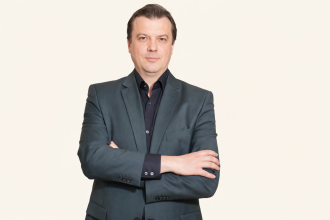
Between the banks of the Nile and the Danube, Romanian Arabist Dr. Laura Sitaru emerges as a living intellectual bridge. She did not merely cross this bridge; she built it with the ink of translation and a profound passion for the Arabic language.
As the Director of the Center for Arabic Studies at the University of Bucharest, she has navigated the linguistic „ocean of Nizar Qabbani” for over two decades. Dr. Sitaru is not just an academic researcher but a traveler through Arabic political thought and a brilliant translator capable of decoding the „diglossia” between Modern Standard Arabic and the Egyptian colloquial—most notably in Khaled Al-Khamissi’s Taxi—to faithfully deliver the pulse of the Arab street to Romanian readers.
In exclusive interview with Atlas News Dr. Sitaru opens her heart to share a journey that has intersected with Cairo and Tunis at various stages. she highlights the role of „Strategic Vision” in strengthening cultural ties and emphasizes that translation is the ultimate weapon in the battle of awareness against digital misinformation.
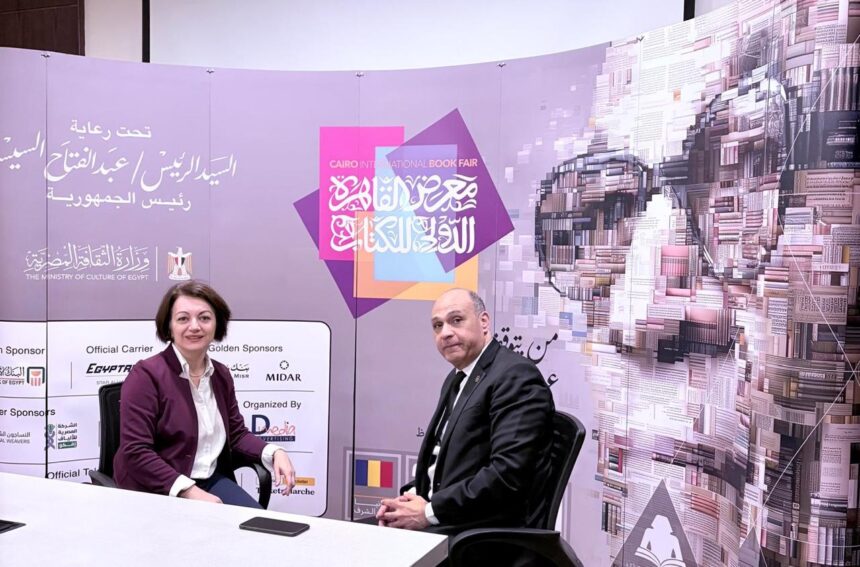
At the Cairo International Book Fair, she sheds light on the Romanian school of Orientalism born out of cooperation with Egypt and discusses her future ambitions to establish „the diplomacy of the word” as the backbone of bilateral relations, calling with confidence for „faith in the future” as the starting point for all shared creativity.

Atlas News: Could you tell us about your journey as a researcher in Arabic Studies and your work at the University of Bucharest?
Laura Sitaru: In recent years, I have specialized in contemporary Arabic literature and translation theories. Within this framework, I translated several modern Arabic novels that have had a significant impact on the literary scene. In 2009, I earned my PhD focusing on the linguistic and historical evolution of political concepts in the Arab world. My interests also extend to travel literature and how Arab travelers influenced the „image of the Other” in Arab and Islamic societies. At the University of Bucharest, I teach applied terminology in economic, financial, and political fields, and I regularly contribute analyses on Arab affairs to Romanian media and cultural publications.
Atlas News: How does translating literary impact cultural relations between Egypt and Romania?
(LS): In cultural research, cultures that lack translation are considered „knowledge-poor.” Throughout history, scientific and cultural information moved between civilizations via translators, leading to mutual understanding. While the number of Arabic specialists in Romania is small, their efforts are immense. Over the last twenty years, we have successfully drawn publishers’ attention to major contemporary Arab writers such as Alaa Al-Aswany, Elias Khoury, Hoda Barakat, Khaled Al-Khamissi, and Samar Yazbek. Today, books are more accessible thanks to fairs and libraries, yet the battle for truth is harder in the age of social media, where misinformation is rampant.
Atlas News: What inspired your interest in Arabic Studies, and how did your research evolve? Can you share some of your notable works?
(LS): One of my professors once said: „The first ten years of learning Arabic are the hardest.” I have passed twenty, because Arabic is an ocean that is difficult to sail. As the beloved poet Nizar Qabbani said, „you must master the art of swimming.” I began at the University of Bucharest in 1997 and continued my studies at the Bourguiba Institute in Tunis and Cairo University’s Faculty of Arts. My PhD research on Arab political thought was conducted through a joint French-Egyptian program at Cairo University. This work was later published as a book in Romania, becoming a key reference for understanding the Arab world.
My other passion is translation. I started during my university days with parts of Ghassan Kanafani’s Men in the Sun and Badr Shakir al-Sayyab’s Rain Song. In 2012, I translated my first full novel, Taxi by Khaled Al-Khamissi. It was a challenge because of the „diglossia”—the interaction between Standard Arabic and Egyptian colloquial. This success opened the door for me to translate works by Hoda Barakat, Samar Yazbek, Adania Shibli, and even Adonis.
Atlas News: What prompted your participation in the Cairo International Book Fair, and what are your expectations?
(LS): I seize any opportunity to return to Cairo; it is the city where I studied during various stages of my academic life. My presence here coincides with the 120th anniversary of diplomatic relations between Romania and Egypt, where Romania is the „Guest of Honor.” As the Director of the Center for Arabic Studies, I am proud that our institution contributed significantly to the Romanian Pavilion’s program.
Atlas News: How do you see the fair’s role in enhancing cultural exchange?
(LS): These meetings are the starting point for deep cooperation. I have met many Egyptian intellectuals here, and we must build on these relationships to strengthen cultural exchange.
Atlas News: Are there Egyptian or Romanian authors who deserve more attention or translation?
(LS): Yes, the field is vast. Only a small fraction of Arabic literature has been translated into Romanian and vice versa. There are new generations of poets and writers whose voices deserve to be heard, some of whom attended the fair recently.
Atlas News: How do you see the future of cultural links between the two countries?
(LS): The link is deep. The very beginning of Arabic studies in Romania is tied to Egypt. In 1994, the Arab League helped establish our Center for Arabic Studies in Bucharest. Partners like ALECSO have helped us host major conferences, recognizing the role of Romanian researchers. On this strong foundation, we can build deeper ties at all levels.
Atlas News: Are there upcoming projects between your center and Egyptian partners?
(LS): We are currently in communication with the National Center for Translation in Egypt. I am certain we will collaborate on multiple projects. Have faith in the future!
Read also
When Literature Builds Bridges: Romania and Egypt in a Cultural Dialogue at Cairo Book Fair