Amr Yehia – Cairo – Exclusive Atlas News
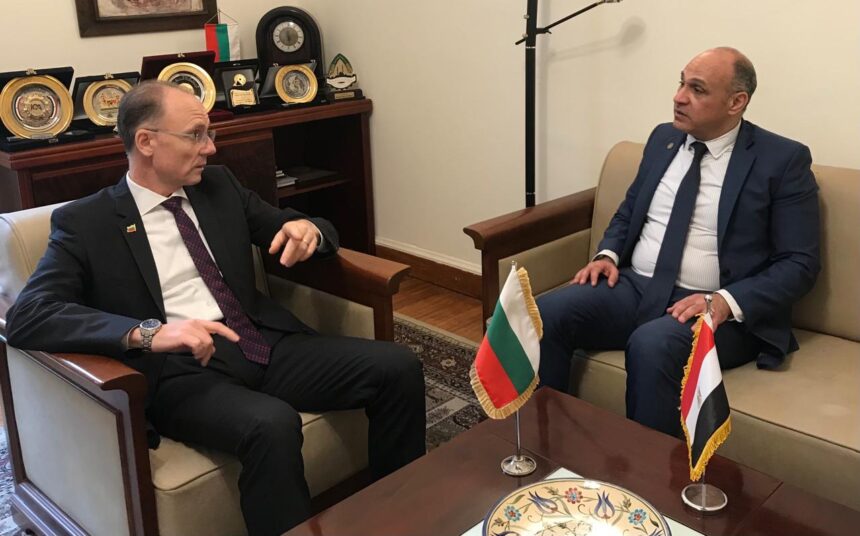
As Cairo and Sofia prepare to mark a full century of diplomatic relations in 2026, ties between Egypt and Bulgaria are entering a new strategic phase, built on historical depth, political trust, and growing economic and security cooperation. In an exclusive diplomatic dialogue, Deyan Katratchev, Ambassador of Bulgaria to Egypt, outlines how a relationship established in 1926 has matured into a forward-looking partnership aligned with regional stability and shared prosperity.
A century rooted in history and continuity
Ambassador Katratchev describes the Egypt–Bulgaria relationship as one of rare continuity, extending well beyond the modern diplomatic era. From ancient civilizational contacts between Thrace and Egypt to medieval exchanges and early modern trade communities in Cairo and Alexandria, the bilateral bond predates the establishment of formal relations.
Egypt became Bulgaria’s first diplomatic gateway to the Arab world in 1926, a milestone that symbolized trust and mutual respect. Over the decades, this relationship endured two world wars, Cold War realignments, and post-Cold War transformations, while remaining constructive and resilient.

According to the Bulgarian ambassador, this historical stability explains why bilateral relations are now poised for elevation to a strategic level during the centennial year.
Political trust as a strategic asset
Among the most durable achievements of the relationship, Ambassador Katratchev highlights political trust and people-to-people ties. These have allowed cooperation to continue even during periods of geopolitical strain.
In recent years, bilateral dialogue has intensified through high-level visits and the activation of new cooperation mechanisms, including a Joint Commission for Cooperation led by the two countries’ foreign ministers. This framework is designed to coordinate long-term priorities and reflect the evolving strategic realities of the EU–Egypt partnership.
President Abdel Fattah El Sisi anticipated visit to Sofia
A central moment of the centennial celebrations is expected to be the landmark visit of President Abdel Fattah El-Sisi to Bulgaria. Ambassador Katratchev confirms that preparations are underway to use this occasion to formally elevate bilateral relations.
Key items on the agenda include energy, transport and connectivity, trade and investment, security cooperation, and enhanced people-to-people contacts. Several agreements are under discussion, particularly in maritime transport, port cooperation between Bulgarian authorities and the Port of Alexandria, and civil aviation, with the aim of establishing direct flights between Cairo and Sofia.
Energy cooperation, including renewable energy and electricity interconnection, is also identified as a priority area, alongside dialogue on labor mobility and migration frameworks.
Egypt as a pillar of regional stability
From Sofia’s perspective, Egypt is viewed as a cornerstone of stability in the Middle East and Africa. Ambassador Katratchev emphasizes Cairo’s pragmatic diplomacy, moderation in regional crises, and role in de-escalation efforts.
Coordination takes place both bilaterally and within multilateral formats such as the European Union and the Union for the Mediterranean. Shared priorities include counter-terrorism, migration management, and support for regional security architectures.
Trade at historic highs
Economic relations have become one of the most dynamic pillars of the partnership. In 2024, bilateral trade reached a record USD 1.81 billion, a year-on-year increase of 41 percent, positioning Bulgaria among Egypt’s top EU trading partners.
Bulgaria has emerged as one of Egypt’s leading wheat suppliers, contributing directly to food security through Black Sea trade routes. Investment cooperation is also expanding, with Bulgarian companies active in IT, outsourcing, food production, agriculture, and textiles. Notably, a Bulgarian investor recently received a “golden license” from Egyptian authorities, signaling growing confidence in Egypt’s investment climate.
Industry, technology, and Vision 2030
Bulgaria’s industrial and technological expertise aligns closely with Egypt’s Vision 2030 objectives. Ambassador Katratchev points to Bulgaria’s strengths in engineering, digital technologies, and artificial intelligence, including the INSAIT AI center in Sofia.
Bulgarian specialists are already involved in major Egyptian projects, including consultancy work on the Al-Dab’aa nuclear power plant. Future cooperation is expected to focus on technology transfer, joint ventures, training, and research, supporting Egypt’s ambition to become a regional economic hub.
Interest in the Suez Canal Economic Zone
The Suez Canal Economic Zone (SCZONE) is attracting growing attention from Bulgarian businesses seeking access to African and Middle Eastern markets. Delegations have already visited the zone, holding exploratory talks with Egyptian authorities on logistics and manufacturing opportunities.
Energy transition and LNG cooperation
Energy is identified as a strategic growth area. A memorandum of cooperation signed in 2024 provides a framework for collaboration in natural gas, LNG, renewable energy, and green hydrogen. Bulgaria supports Egypt’s role as a regional energy hub and backs electricity interconnection projects linking Egyptian renewable energy to Europe.
Culture, education, and people-to-people ties
Cultural diplomacy remains a defining feature of bilateral relations. The centennial year will be marked by concerts, exhibitions, film screenings, and archaeological showcases, including performances by the renowned Bulgarian choir The Mystery of Bulgarian Voices in Cairo and Alexandria.
Educational cooperation also remains strong, with scholarships and academic exchanges in medicine, engineering, IT, and sciences, alongside institutional partnerships between Bulgarian and Egyptian research academies.
Tourism and connectivity
Tourism is another sector with significant untapped potential. Bulgaria’s Black Sea coast and cultural heritage complement Egypt’s Red Sea resorts and historical sites. The number of Bulgarian tourists visiting Egypt reached historic levels in 2024, and both sides are working to expand direct air connections to further stimulate exchange.
Toward a strategic partnership
As the centennial approaches, Egypt and Bulgaria are positioning their century-old relationship as a platform for future cooperation. Built on trust, historical continuity, and converging strategic interests, the partnership is set to move beyond symbolism toward concrete economic, energy, and security outcomes for both societies.
Read also: 120 Years of Romania–Egypt Relations: A Diplomacy That Has Traversed History