Atlas News – Editorial Analysis – Tiberiu Constantinescu
The United States’ intervention in Venezuela was a test of political nerve, speed, and strategic clarity. It was a test that Europe observed from the sidelines — and one that Romania faced on its knees, hands neatly folded behind its back. Not because it lacked the capacity to speak, but because it chose not to speak with its own voice.
Official messages from Bucharest — both from Foreign Minister Oana Țoiu and Prime Minister Ilie Bolojan — converged on the same sterile formula: “Romania is aligned with its European partners.” No sentence on the legitimacy of the intervention. No political assessment. No line drawn. No responsibility assumed. Only alignment. Repeated. Mechanically. Like a Pavlovian reflex of a diplomacy that has abandoned the ambition of independent thought.
When a country’s leaders cannot produce a statement that begins with “Romania believes” and can only manage “Romania aligns”, this is no longer foreign policy. It is compliant administration.


Europe Watched, the United States Acted
While Washington decided, executed, and altered realities on the ground, Europe responded exactly as it has grown accustomed to doing: with appeals, expressions of concern, and carefully balanced statements. European leaders invoked international law, the United Nations, and the need for a peaceful transition. Correct in legal terms. Politically harmless.
There was no initiative. No visible attempt at mediation before the intervention. No leverage deployed. No pressure exerted. Only post-factum reactions, formulated in the language of academic seminars rather than geopolitical crises.
Europe was not an actor. It was a spectator equipped with official credentials. A continent that still presents itself as a “normative power,” yet, when the moment of decision arrives, matters only as a producer of communiqués.
Romania – The Appendix Awaiting a Signal
In this context, Romania’s position is more troubling than Brussels’ inertia. Because Bucharest did not even attempt to simulate an autonomous voice. Romanian diplomacy functioned as an appendix: waiting for signals from major capitals, calibrating tone, then delivering a diluted, more cautious local version.
There is no indication that Romania sought to influence a European position. No sign that it raised uncomfortable questions. No trace of strategic thinking. Only conformity.
This is not prudence. It is the absence of a backbone.
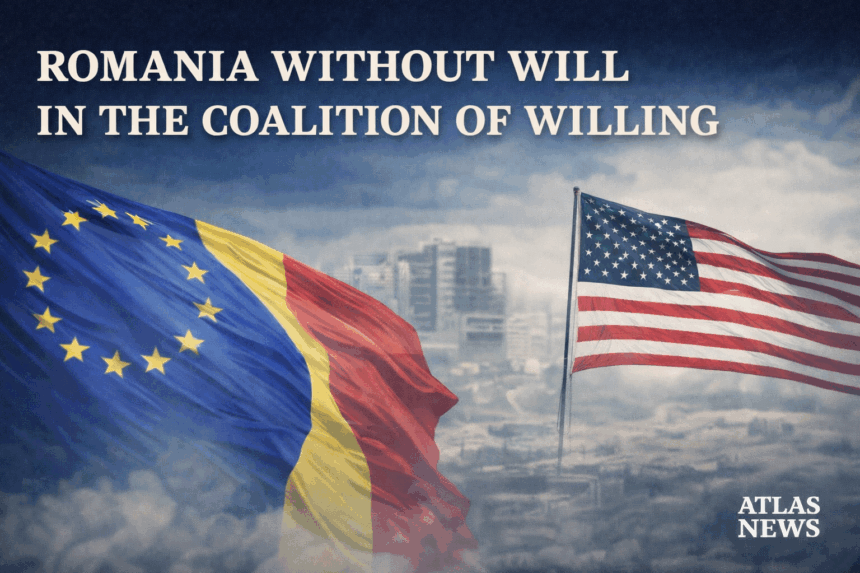
A “Coalition of Willing” Without Will
The irony is that Romania claims membership in a so-called “Coalition of Willing”, yet refuses to demonstrate precisely what the name implies: political will. The will to speak before others decide. The will to risk a position. The will to disturb.
In practice, Romania behaves like the valet of a weary nobleman — Europe — hoping that by remaining sufficiently useful and sufficiently silent, it might someday secure a seat at the table of major decisions. The problem is that the table has moved, and the nobleman is no longer the guest of honor.
Diplomacy as an Exercise in Mimicry
What we are witnessing is not a communication mishap, but a pattern. Romania no longer produces foreign policy; it produces diplomatic mimicry. It copies formulas, avoids substance, and hides behind the “European consensus” even when that consensus is empty.
In moments of consequence, silence is not neutrality. It is positioning. And Romania’s positioning, in this case, is one of deliberate irrelevance.
Atlas News Editorial Conclusion
Europe lives on memories. Romania lives on reflexes. And in a world where decisions are made swiftly and brutally, both risk being pushed to the margins. The difference is that Romania still has the opportunity to decide whether it wants to be an actor — or merely part of the inventory.
For now, it has chosen to be furniture.
This article represents an editorial analysis by Atlas News. The views expressed reflect the editorial position of the newsroom, based on public statements and the current geopolitical context.